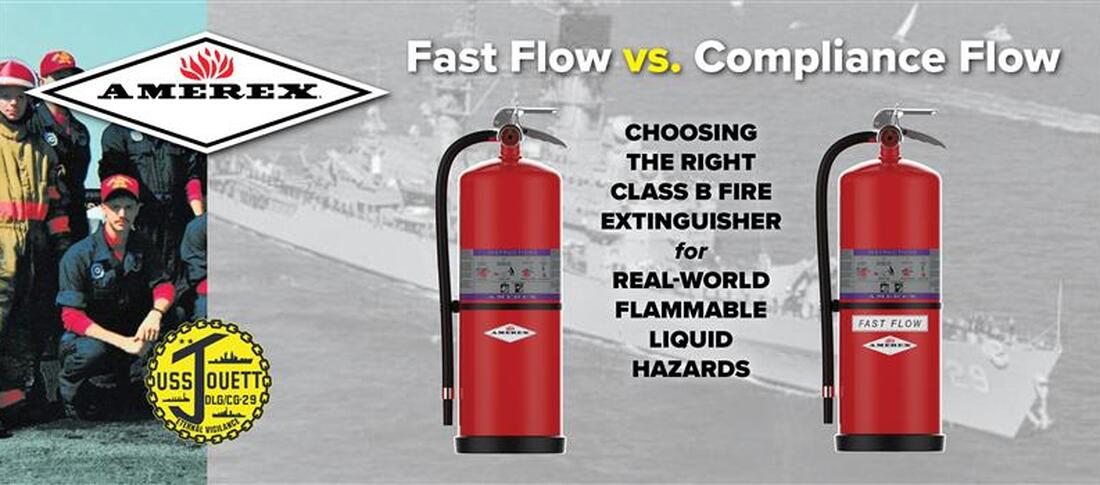
Flammable liquid fires rarely behave like simple spill or pan fires. In real world industrial, military, and commercial environments, flammable liquids are stored on shelves, inside cabinets, pressurized, or contained in complex equipment—creating three dimensional, obstacle driven fire hazards that demand a faster, more powerful response.
When flammable liquids are under pressure or burning in elevated or obstructed spaces, Class B fires require a dry chemical extinguisher capable of delivering at least 1 pound per second. This “Fast Flow” performance is essential to match the flow of escaping fuel and achieve rapid extinguishment.
This article explains the critical differences between Compliance Flow vs. Fast Flow fire extinguishers, and why selecting the right Class B extinguisher—based on NFPA 10, UL ratings, and the fire dynamics of pressure and 3D fires—can determine the outcome of an emergency. Two real world stories illustrate how flow rate directly impacts effectiveness in flammable liquid fire scenarios.

Compliance Flow
During my teenage years, I was a member of the U.S. Naval Sea Cadet Corp, which is a youth group for kids who plan to join the Navy or Coast Guard. That experience took me to a two-week Navy boot camp in San Diego, CA. One of the things we did was visit the shipboard firefighting school on the 32nd Street Naval Station. There, a team of professional fire fighters tipped over a 55-gallon drum of jet fuel and lit it on fire. The Sea Cadets had fire turnouts and breathing apparatus, and the fire fighters helped us all extinguish that fire with 30 lb Purple K Fire Extinguishers repeatedly.
FAST FLOW!
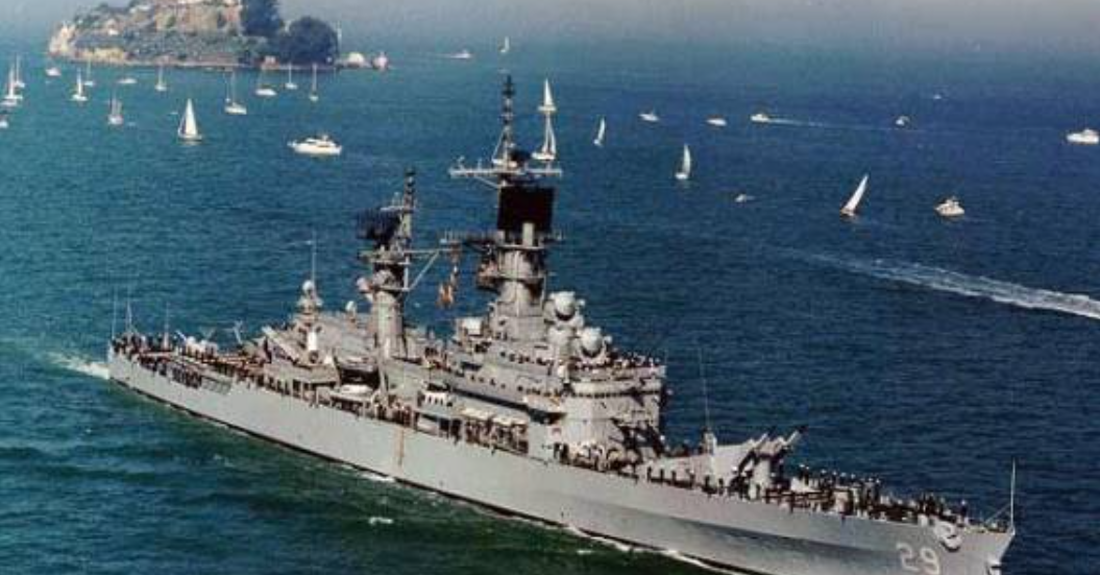
It’s 1990, I am 20 years old, living on the U.S.S. Jouett (CG-29) sailing through the Indian Ocean, Iraq has invaded Kuwait and we are making our best speed to the Persian Gulf, pushing the limits of our 1966 Guided Missile Cruiser.
Gong! Gong! Gong! "General Quarters, General Quarters! All hands man your battle stations. Up and forward to starboard, down and aft to port. Set material condition Zebra throughout the ship. This is not a drill! Class B Fire #1 Engine Room!”
I was a Damage Controlman 3rd Class back then and the Investigator on the Flying Squad/At Sea Fire Party, which meant that I was the first on scene right after the Machinist Mates working in the Engine Room. When I grabbed a 30 lb Purple K extinguisher and headed down the ladder, I found a lube oil spray fire on the main bearings supporting the ships drive shaft. The flames were shooting at least 15’ and the Machinist Mate in the space had already discharged an entire 30lb Purple K. I handed him mine and grabbed another, it took 7, 30lb Purple K units to extinguish that fire and it only went out after the lube oil pump was shut down.
I have never forgotten how the Machinist Mates could not quite get the entire fire extinguished. They battled that fire with strong technique and quality equipment, limiting damage until the lube oil pump was shut down. What we know today is that a Class B pressure fire demands a dry chemical extinguisher that flows at least 1 pound per second, this flow rate will match the flow of the escaping fuel facilitating extinguishment. Had the Machinist mates in #1 Engine Room had fire extinguishers with a 1 pound per second flow rate, they could have made quick work of that fire allowing them to close the isolation valve just a few feet away potentially saving the bearing.
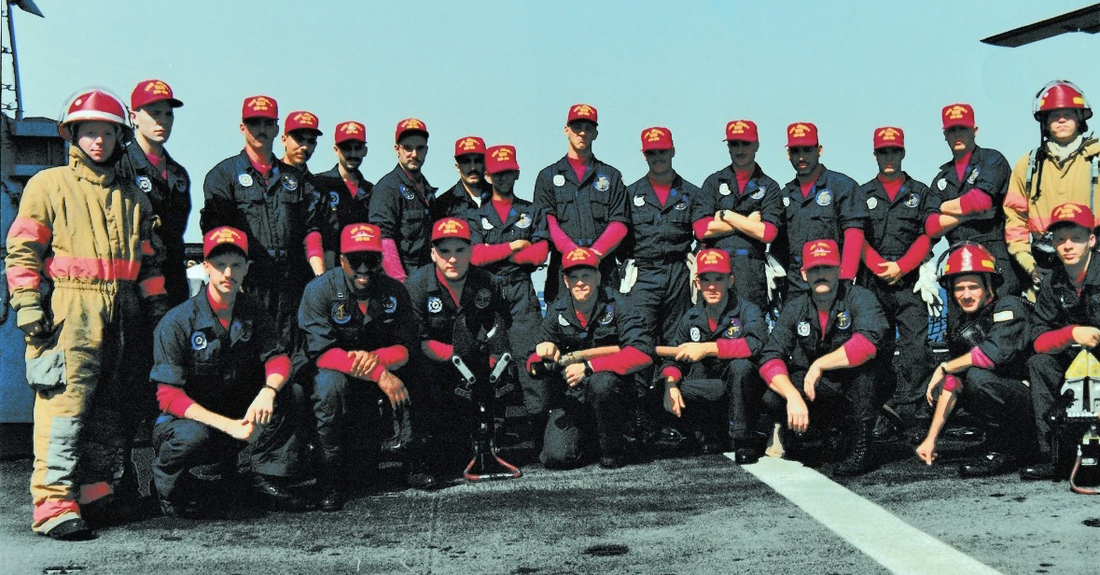
Both Class B fires were fought with essentially the same fire extinguisher, with two very different results. The spill fire went out easily because Purple K is the most effective agent for class B fires and spill is easy to apply agent to. The long extinguisher discharge time enabled us to extinguish it repeatedly. The bearing lube oil pressure fire demanded 1 pound a second for extinguishment and only went out after the pump was shut down.
Selecting the correct Class B fire extinguisher isn’t just a compliance decision—it’s a performance decision that can change the entire outcome of a flammable liquid emergency. As real‑world scenarios demonstrate, Compliance Flow extinguishers may meet minimum standards, but Fast Flow extinguishers are engineered for the pressure-fed, three‑dimensional, and obstacle fires technicians actually face.
NFPA 10 and Amerex Tech Tip #47 make it clear: when dealing with pressurized or complex Class B hazards, a 1 lb-per-second discharge rate is essential for timely and effective extinguishment.
Whether you’re a fire protection professional, safety director, or technician in training, understanding how flow rate, UL ratings, and real-world hazard dynamics intersect is critical. Choosing the correct extinguisher—especially the Amerex Z-Series Fast Flow models—ensures you’re prepared for the fires that don’t behave like textbook scenarios.
If your team handles or stores flammable liquids, make sure your Class B extinguishers are equipped for the job. Because when seconds matter, flow rate matters.
To learn more about the z-series